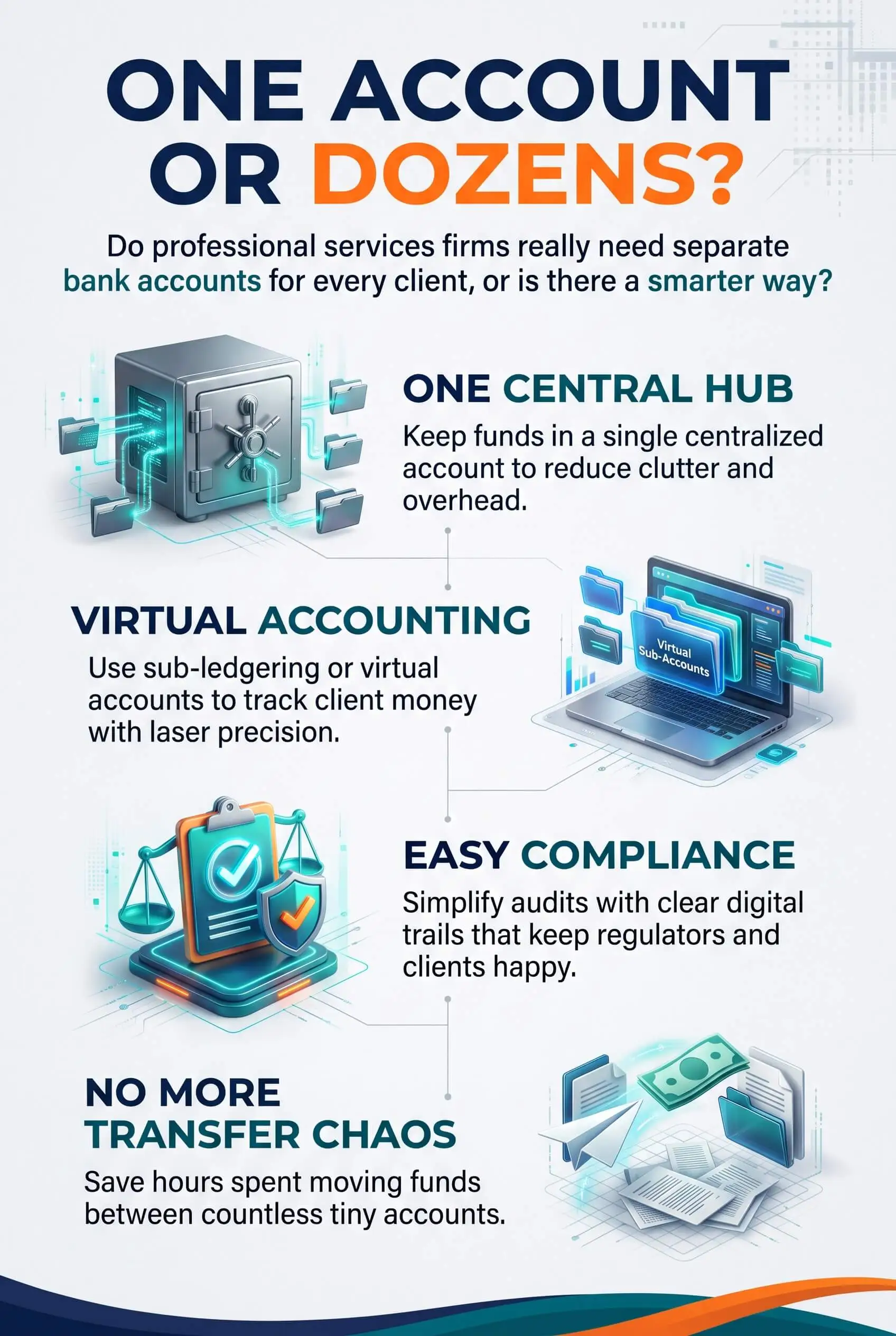
Opening a new bank account for every client feels like control. For most professional services firms, it is extra reconciliation work dressed up as organization. What your firm needs is a clear record of every client inside the books, plus a trust account any time you hold money a client has paid but your team has not yet earned.
We see the same shortcuts again and again. A consulting firm opens a checking account for each new retainer. A design studio runs client reimbursements through the payroll account and later cannot tell which costs belong to whom. A small law practice drops an advance fee into operating because the work will be done by Friday. None of these choices looks risky on the day it happens. Months later, each one surfaces as a reconciliation that will not balance.
Sound accounting for professional services firms starts with two questions: whose money is this, and which client does it belong to? Answer those cleanly and the account structure becomes an easy call.
TL;DR Quick Answers
Accounting for Professional Services Firms
Accounting for professional services firms tracks money by client and project, because a firm's inventory is its team's time and expertise. Most firms need one operating account and clean client-level tracking, not a separate bank account for every client.
Job and project costing: Shows which clients, projects, and practice areas drive profit.
Utilization and realization rates: Measure how much billed time turns into collected revenue after write-downs.
WIP and pipeline reporting: Keeps unbilled work visible and smooths out feast-or-famine cash flow.
Trust accounting: Holds unearned retainers and client funds apart from operating money, with a ledger for each client.
Partner compensation: Gives draws and distributions accurate reporting tied to actual cash flow.
Top Takeaways
One operating account is enough for most professional services firms.
Every firm needs client-level tracking, whatever its bank setup looks like.
Unearned client money belongs in a trust or client account, with a ledger for each client.
For lawyers, commingling is a violation even when it happens by accident.
Retainers belong on the books as a liability until your team bills the work.
What "Separate Accounts" Means in Practice
Firm owners who ask this question usually mean one of three different things. The answer changes with each.
A separate bank account per client: Usually unnecessary. Consultants, agencies, architects, engineers, and IT firms run one operating account and do the separating inside their books.
A trust or client money account: Required whenever you hold funds that belong to a client and have not been earned. Most firms use one pooled account with a ledger for each client and open a single-client account only for large balances held over a long stretch.
Client-level tracking in your accounting system: Always needed. Without it, you cannot see which clients drive margin or prove where a payment came from.
When a Bank Account Per Client Adds Work Without Adding Clarity
If every deposit is money you have already earned, extra bank accounts mostly give you extra reconciliations and more places for a payment to land in the wrong spot.
Double-entry bookkeeping already solves this. Money moves through one operating account. Your team tags every invoice and direct cost to the client and project it belongs to, so the bank balance stays simple while your reports show each client on its own line.
When Client Money Has to Stay Apart
Everything changes the moment you hold money that is not yet yours. Advance retainers, settlement proceeds, pass-through funds, and deposits for third-party costs all belong to the client until you earn them or pay them out.
For lawyers, this is a rule. ABA Model Rule 1.15, along with each state's version of it, requires attorneys to keep client funds in a trust account separate from firm money and to maintain complete records for every client. Mixing the two is called commingling. It counts as a violation even when it happens by accident and no client loses a dollar.
Accounting bodies take a similar line. ICAEW permits pooled client accounts but expects firms to open a designated account for one client when a large balance will sit for an extended period. Firms outside regulated professions still benefit from the same discipline, which is why we recommend booking unearned retainers as a liability until your team bills the work. The same attention to proper fund management, accurate reporting, and financial transparency is essential in trusted nonprofit accounting.
Which Setup Fits Your Firm
Consulting, marketing, or creative agency billing after the work is done: One operating account is enough. Track each client in your books.
Firm that collects advance retainers: You rarely need a separate account per client. Hold retainers in a trust or client money account, or at minimum book them as a liability until earned.
Law firm holding retainers or settlement funds: You need a client trust account (IOLTA or similar) with a ledger for each client. A dedicated account for one client makes sense only for large, long-held sums where the interest belongs to that client.
Accounting or bookkeeping firm handling client money: You need a client money account wherever you hold client funds, and your licensing body may expect a designated account for large balances held long term.
Architecture or engineering firm with reimbursable costs: You need no trust account unless you hold client deposits. Track each client by project so reimbursables get billed back in full.
Every firm on that list shares one requirement, and it is client-level tracking. That visibility sits at the core of accounting for professional services firms because it ties the cash in your bank to the work your team delivered. Outsourced bookkeeping services can help maintain that visibility by keeping client transactions organised, records accurate, and financial reports up to date. You should not have to guess which clients drive margin, which retainers are underpriced, or how much unbilled work in progress is sitting on the books.
How to Track Every Client Without Opening Dozens of Accounts
Set up your chart of accounts by service line: Group revenue and direct costs by the type of work you deliver, not by client name.
Tag every transaction to a client and project: Classes, projects, or customer jobs in your accounting software let you filter any report by client.
Book retainers as a liability: Record advance payments as unearned revenue and move them to income as you bill against them.
Connect time tracking to billing: When you link QuickBooks Time or Harvest to your books, you see realization by client, write-downs included, instead of hours logged alone.
Reconcile every month: An error is far easier to fix in week four than in month eleven.
Run a three-way reconciliation on trust funds: The bank balance, the trust account book balance, and the total of all client ledgers should match every time.

"When a firm asks whether it needs a separate account for every client, our answer is usually no. It needs better reporting by the client. Across the professional service firms we support, the expensive problems rarely trace back to having too few bank accounts. They come from retainers booked as revenue the day they arrive and reimbursements buried in operating expenses. By the time the partners ask which clients are profitable, nobody can answer with confidence. We fix the tracking first. After that, choosing an account structure is easy."
7 Essential Resources
We pulled these sources together because each one shapes how a professional services firm separates and tracks client money.
ABA Model Rule 1.15: Safekeeping Property: The baseline US rule requiring lawyers to keep client funds apart from their own and to maintain complete records.
ICAEW Clients' Money FAQ: Practical answers on when accountants can pool client money and when ICAEW expects a designated account.
IRS: What Kind of Records Should I Keep: Federal guidance on the records and supporting documents a business should hold onto.
QuickBooks Online: Get Started With Class Tracking: How to tag income and expenses by segment so you can filter reports by client or service line.
CosmoLex: What Bank Accounts Should a Law Firm Have: A plain breakdown of operating, savings, and client trust accounts.
Ramp: Commingling Funds at Law Firms: How commingling tends to happen by accident, and the controls that stop it.
Relay: How to Set Up Bank Accounts for Bookkeeping Clients: A purpose-based account setup that keeps reconciliation simple.
If duplicate transactions are already muddying your client ledgers, read this guide on catching duplicate entries before tax time next.
3 Statistics
Billable utilization averaged 66.4% in 2025, the lowest in SPI Research's survey history. SPI surveyed 509 professional services teams, and roughly a third of their available hours went unbilled. Client-level tracking is how a firm finds out where those hours went. Source: Certain analysis of the 2026 SPI Professional Services Maturity Benchmark
Average EBITDA for professional services organizations held at 9.9% in 2025. At that margin, one underpriced retainer can quietly drain a meaningful share of profit, and pooled books will not show it. Source: Certain analysis of the 2026 SPI Professional Services Maturity Benchmark
ABA Model Rule 1.15 requires lawyers to keep complete trust account records for five years after a representation ends. That turns client-level records into a compliance duty. Source: ABA Model Rule 1.15
Final Thoughts and Opinion
We think the money you hold should decide your account structure, and the clients you serve should decide your reporting.
If you never hold client funds, one operating account is enough. Adding more will not make the books any clearer. If you do hold client money, keep it in a trust or client account, track it by client, and move it only after your team has earned it. Those habits protect your clients and your firm's reputation at once.
The bigger gap sits in the middle ground. We regularly meet firms that keep one tidy operating account and do no client-level tracking at all, and that setup hides scope creep and unbilled work until year-end, when fixing it costs far more. Any organization holding money for others faces the same test. Even independent schools keep tuition and deposits organized family by family for this reason.
If bookkeeping is starting to crowd out billable hours at your firm, weigh whether outsourcing your accounting makes sense.
Frequently Asked Questions
Do consultants need a separate bank account for each client?
No. Consultants who bill after the work is done can run every client through one operating account. You do the separating in the books by tagging each invoice, payment, and expense to its client and project. A separate account only makes sense once you start holding a client's money before earning it.
What is commingling, and why does it matter?
Commingling means mixing client money with your firm's own funds in the same account. For lawyers, it breaks ABA Model Rule 1.15 and state ethics rules even when there is no intent and no loss. For other firms, it blurs the line between earned revenue and money you still owe clients, and every report built on those numbers inherits the distortion.
Can one trust account hold money for multiple clients?
Yes. A pooled trust account, such as an IOLTA account for lawyers, can hold funds for many clients as long as each one has its own ledger. Your state's rules may require a dedicated account for a single client when a large balance will sit long enough to earn meaningful interest for that client.
How should a firm account for retainers paid in advance?
Record the retainer as unearned revenue, which is a liability, on the day it arrives. As your team completes work and bills against it, move the earned portion to income. Law firms must also hold unearned retainers in trust. Doing it this way keeps revenue accurate and shows exactly how much you still owe each client.
How do I track profitability by client?
Tag every income and direct cost transaction to a client using classes, projects, or customer jobs in your accounting software. Connect your time-tracking tool so hours flow into billing. Then review client-level profit reports each month, while there is still time to catch scope creep and underpriced work.
When should a firm bring in outsourced accounting help?
Bring in help when partners are spending non-billable hours on bookkeeping, when retainers and trust balances are getting hard to reconcile, or when nobody can say which clients are profitable. An outsourced team can set up client-level tracking, run the monthly close, and give you reporting that supports pricing and hiring decisions.
Get Clarity on Your Client Accounts
Not sure your current setup is showing you the numbers you need? Book a 30-minute intro call with Accountix Solutions. We will look at how your firm handles client funds, retainers, and reporting, and point out where a cleaner structure would help most. Our professional accounting services are designed to help firms gain better financial visibility and maintain accurate, reliable reporting. No sales pitch. Just clarity.