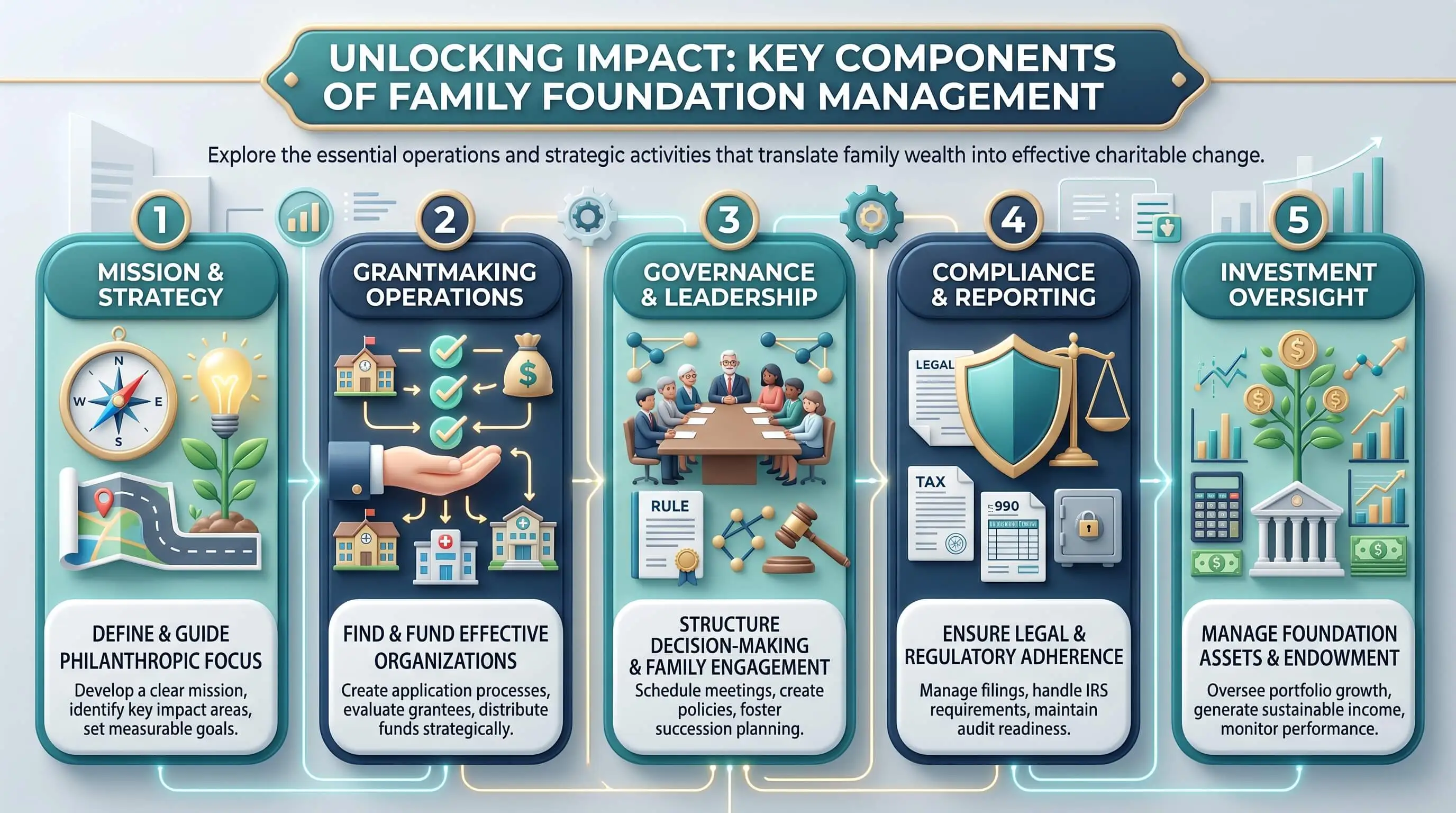
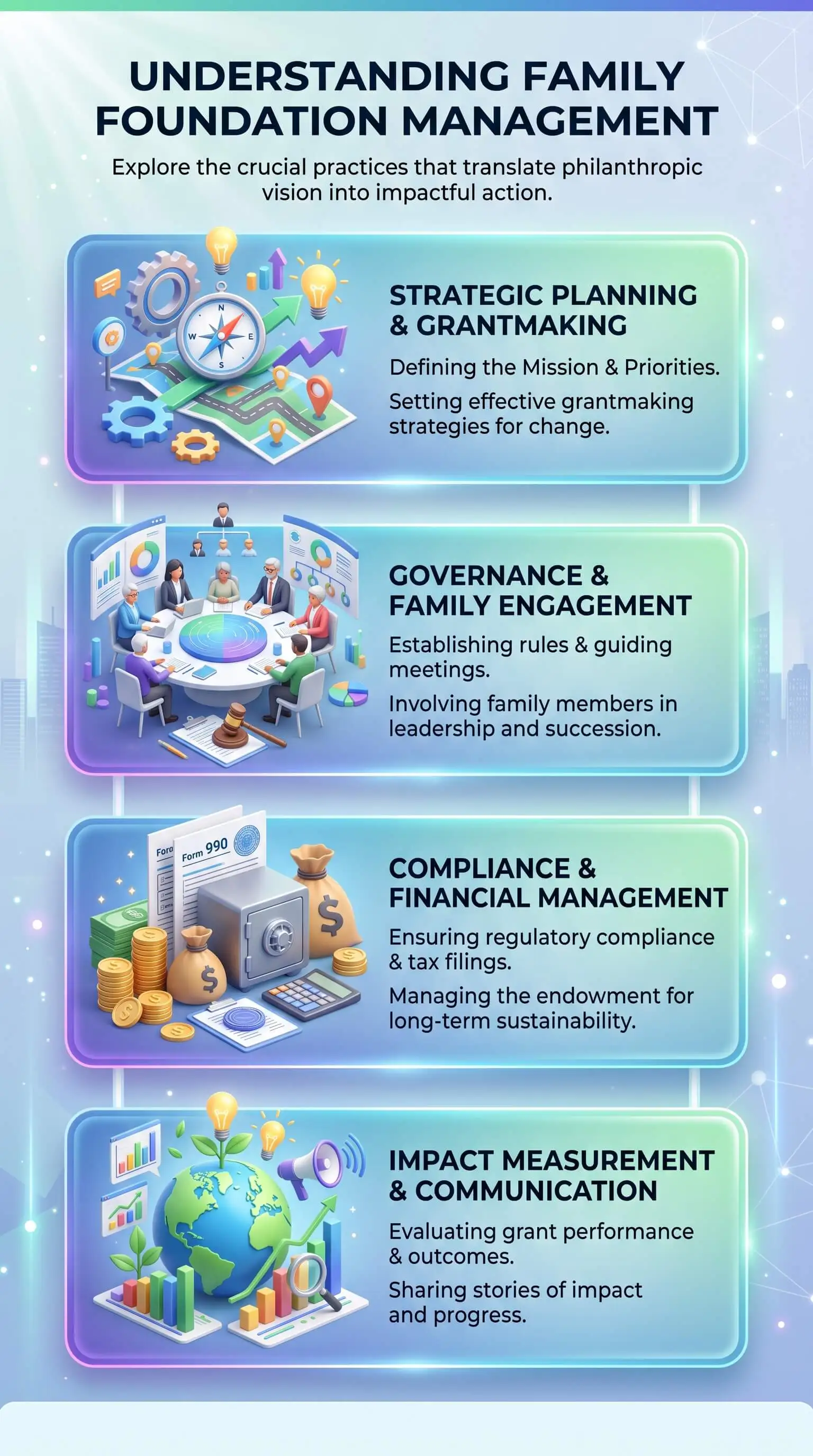
A family's first Form 990-PF is often the moment its foundation stops feeling like a gift and starts feeling like an organization. Family foundation management covers six areas of work: governance, grantmaking, IRS compliance, financial oversight, administration and recordkeeping, and family engagement. Each one needs an owner and clean records.
We see the same moment with many of the families we serve. A foundation launches with a clear purpose and a few meaningful gifts. A year or two later, the board minutes are behind, grant letters sit in three different inboxes, and the Form 990-PF becomes a spring scramble with the CPA. Generosity is common. A repeatable process is not, and that gap is where philanthropic planning services do their most useful work.
Below, we break down what each area involves, where families tend to lose momentum, and how family foundation management and philanthropic planning services fit alongside your CPA and attorney. The fundamentals hold whether your foundation funds one scholarship at a local private school or a decades-long community mission.
TL;DR Quick Answers
Family Foundation Management and Philanthropic Planning Services
Family foundation management is the ongoing work of running a private family foundation. Philanthropic planning services coordinate that foundation with the rest of a family's giving, tax, and estate plan so charitable capital is deployed with clarity and intention.
Foundation management covers: governance and board calendars, grantmaking and due diligence, Form 990-PF and payout compliance, investment coordination, recordkeeping, and next-generation engagement.
Philanthropic planning adds: a values-based giving strategy, the right mix of vehicles (foundations, donor-advised funds, charitable trusts), and giving timed with tax planning all year.
Who does what: your CPA and attorney remain the technical experts, and a family office coordinates the strategy, workflows, and follow-through.
The payoff: clean records, fewer year-end surprises, and a repeatable process the next generation can steward.
Top Takeaways
Scope: Family foundation management spans governance, grantmaking, compliance, financial oversight, administration, and family engagement.
Ownership: Most foundation problems trace back to unclear responsibility, not a shortage of generosity.
Coordination: Form 990-PF, the payout requirement, and excise taxes run smoothly when the CPA and attorney are involved year-round.
Context: A foundation works best as one part of a giving plan that may also include donor-advised funds or charitable trusts.
Continuity: The next generation needs a seat, a defined role, and a timeline to step into it.
What Family Foundation Management Means
A private family foundation is a charity funded with a family's assets and usually governed by family members. The IRS treats it like any other private foundation, with the same reporting and giving requirements.
Managing one well means running it with the same discipline you would bring to a family business. For many families, that work sits inside a broader family office, where one team coordinates giving with tax, estate, and investment planning.
The Six Core Areas of Family Foundation Management
Every well-run family foundation handles these six areas, whether the board meets twice a year or every month.
Governance and Board Structure
Governance is how the foundation makes decisions. That means bylaws, officer roles, a conflict-of-interest policy, and a board calendar people actually follow. Minutes matter more than most families expect, because they are the record that the board acted with care.
Grantmaking Strategy and Due Diligence
Grantmaking turns a mission into action. The foundation sets focus areas, vets each grantee, confirms charitable status, documents the grant, and follows up on what it accomplished. Education is a common focus for the families we work with, from scholarship funds to tuition support that helps families afford private school.
IRS Compliance and Annual Filings
Compliance keeps the foundation in good standing. Each year, a private foundation files Form 990-PF, meets a minimum distribution requirement, avoids self-dealing with family members and related parties, and pays an excise tax on net investment income. Your CPA and attorney remain the technical experts. Our job is making sure they have clean information well before a deadline.
Financial Oversight and Investment Coordination
A foundation needs an investment policy, enough liquidity for its grant schedule, and accounts that reconcile. When the portfolio and the grant budget are planned together, the payout requirement never forces a rushed sale in December.
Administration and Recordkeeping
This is the quiet work that holds everything else up: contribution records, grant files, acknowledgment letters, board documents, and a retention system. Organized records turn tax season into a routine.
Family Engagement and Succession
A family foundation is also a family practice. Younger members need a seat at the table and responsibility they can own, with enough education to use both well. Stewardship is learned by doing. Without a succession plan, even a well-funded foundation can drift when leadership changes hands.
How Philanthropic Planning Services Fit Around the Foundation
A foundation is one giving vehicle, not the whole plan. Philanthropic planning services look across every structure the family uses, how giving is timed with tax planning, and how charitable goals connect to estate and wealth transfer decisions.
The families who get the most from their foundations treat giving with investment-level discipline. Their CPA, attorney, and family office team, including support through outsourced family office executive services, work from the same priorities, so nothing gets decided in isolation or at the last minute.
Foundation, Donor-Advised Fund, or Trust?
Some families ask whether they need a foundation at all. The answer depends on how much control, involvement, and administration the family wants to take on.
Private family foundation: the family board directs grants and investments, so control is highest. So is the workload, which includes a board, annual filings, and a required minimum distribution. The foundation also discloses its grants publicly. It fits families who want multigenerational involvement and long-term continuity.
Donor-advised fund: the donor recommends grants and the sponsor approves them. The sponsor handles most of the administration, there is no federal minimum payout, and anonymous giving is possible. It suits simpler, flexible annual giving.
Charitable trust: the trust document sets control and payout at creation, and a trustee handles ongoing duties and filings. It works well when giving needs to pair with income or estate goals.
Plenty of families use more than one. A foundation can anchor the legacy while a donor-advised fund handles smaller annual gifts, with family office trust and business transition services helping coordinate philanthropy alongside broader trust, succession, and business planning.
"Most of the families we sit down with have been generous for years. What they're missing is follow-through: someone keeping the minutes, tracking every grant, and getting the CPA and attorney in the same conversation before a deadline instead of after it. We've learned from our office in West Des Moines that structure makes giving more personal, not less. It's how a family hands the next generation a purpose along with the paperwork already in order."
7 Essential Resources
We point families to these when they want to understand the work before deciding who should carry it.
1. A Plain-English Primer on Private Family Foundations (Fidelity Charitable)
A clear look at how family foundations are funded and governed, and how they compare with donor-advised funds. Start here if you are still choosing a vehicle.
Source: https://www.fidelitycharitable.org/guidance/philanthropy/private-family-foundation.html
2. Setting Up Board Roles and Leadership (UBS)
Covers officer roles, director duties, and the rules on paying family members. Many of the governance questions we hear in a foundation's first year are answered here.
3. What Outsourced Foundation Administration Looks Like (Foundation Source)
Shows how administration, tax preparation, and technology can live with one provider. Useful for picturing the back-office side of the job, whoever ends up doing it.
Source: https://foundationsource.com/manage-a-foundation/
4. The Six Excise Taxes Every Foundation Should Know (Exponent Philanthropy)
A short refresher on self-dealing, payout, excess business holdings, and the other penalty taxes. We suggest reviewing it with your CPA before each fiscal year starts.
Source: https://exponentphilanthropy.org/blog/six-excise-taxes-every-private-foundation-needs-to-know/
5. How the 5 Percent Payout Rule Works (Philanthropy Roundtable)
Walks through the minimum distribution math with a worked example. It makes the link between the investment plan and the grant budget easy to see.
Source: https://www.philanthropyroundtable.org/resource/private-foundations-and-the-5-percent-payout-rule/
6. Governance, Succession, and Next-Generation Guides (National Center for Family Philanthropy)
NCFP's Knowledge Center collects tools on board practice, family dynamics, and bringing younger members into giving. For families planning across generations, this is the one we recommend most often.
Source: https://www.ncfp.org/knowledge-center/
7. Building a Grantmaking Strategy That Fits Your Values (TCC Group)
A practical overview of grant strategy, evaluation, and board operations. Helpful when a family wants its giving to feel more focused and less reactive.
Source: https://www.tccgrp.com/service/family-foundation-consulting/
3 Statistics
1.39% excise tax on net investment income. For tax years beginning after December 20, 2019, most private foundations pay a flat 1.39% federal excise tax on net investment income and report it on Form 990-PF. The rate is modest. The requirement to estimate, pay, and report it correctly every year is what trips families up.
Source: https://www.irs.gov/charities-non-profits/private-foundations/tax-on-net-investment-income
30% penalty on undistributed income. When a private foundation misses its required distributable amount, the IRS charges a 30% excise tax on the shortfall, plus an additional 100% tax if it stays uncorrected. Of all the foundation rules, this one most clearly rewards keeping the grant calendar and the portfolio on the same plan all year.
71% of family foundations now give above the 5% minimum. The National Center for Family Philanthropy surveyed more than 500 family foundations for its Trends 2025 report and found 71% exceed the required 5% payout, up from 56% in 2020. More giving means more grants to track, which makes clean records matter even more.
Final Thoughts and Opinion
After years of coordinating family giving, we have seen most foundations stall for one reason: nobody owns the work. How heavy the work is rarely decides it.
The pattern is familiar. The board means well, but no one keeps the calendar. The CPA learns about a large grant after year-end. The children are interested, and nobody has offered them a seat.
What consistently works for the families we serve:
A mission and grant focus everyone in the family can explain in two sentences
A board calendar tied to filing deadlines and payout targets
One organized home for grant files, receipts, and minutes
A standing line of communication between the family, the CPA, and the attorney
The fifth habit takes longer, and it matters most. Families who bring the next generation in before a transition forces the issue keep their foundations on course.
Good family foundation management feels quiet. Grants go out on schedule, records are ready when the CPA asks, and board meetings are spent on impact instead of paperwork. Philanthropic planning services earn their keep by making what a family already does repeatable. For families who give to education, including the schools that shape their communities, that consistency is what turns a single gift into a lasting commitment to supporting private schools and the students they serve.
Frequently Asked Questions
What does a family foundation manager do?
They keep the foundation running between board meetings. Day to day, that means maintaining the board calendar, processing and tracking grants, organizing records, and getting the CPA what they need for filings, so the family can make decisions with full information.
What are the main IRS rules for private family foundations?
Family foundations follow the same rules as every private foundation. Each year they file Form 990-PF, meet a minimum distribution requirement, avoid self-dealing with family members and related parties, and pay an excise tax on net investment income. Your CPA and attorney should guide the technical details.
Is a donor-advised fund easier than a family foundation?
Usually. The sponsor of a donor-advised fund handles most of the administration, and there is no federal minimum payout. A foundation gives the family more control and a lasting structure for involvement, in exchange for a board, annual filings, and ongoing records. Many families use both.
Can family members be paid to help run the foundation?
Yes, as long as the pay is reasonable and necessary for the work performed. Written job responsibilities and documented pay decisions protect both the family and the foundation. Have your attorney review any arrangement before it starts.
How do we involve the next generation?
Start early and give them something to own. A junior board seat, a small discretionary grant budget, or a role in site visits all work. In our experience, responsibility builds engagement faster than watching from the sidelines.
Does a family office replace our CPA or attorney?
No. Your legal and tax professionals remain the technical experts. At Legacy Bridge, we coordinate the strategy and implementation so everyone works from the same plan and the same timeline.
Ready to Give Your Family's Philanthropy More Structure?
If your foundation has started to feel more like paperwork than purpose, a clearer framework can bring back the clarity and intention you started with. The Legacy Bridge family office team provides multi family office wealth management services and works alongside your CPA and attorney to organize governance, grants, and records into a process the next generation can carry forward.
Schedule a private consultation to talk through where your foundation stands today and what a more intentional approach would look like for your family.