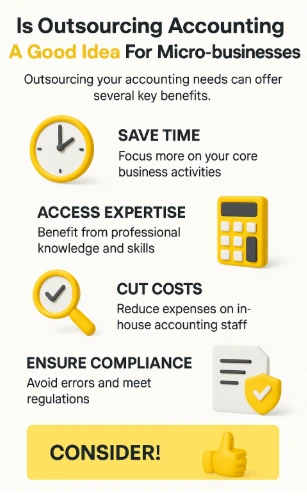
Is outsourcing accounting a good idea for micro-businesses?
From our work with hundreds of micro-business owners at Accountix Solutions, we’ve seen a consistent pattern: the moment a founder stops battling their books, their decision-making sharpens and their business momentum increases almost overnight. Most people assume outsourcing is only for larger teams—but in reality, the smallest businesses often benefit the most.
Many micro-business owners come to us feeling stretched thin, second-guessing their numbers, or spending late nights fixing bookkeeping mistakes that quietly cost them growth. Based on our first-hand experience, outsourcing isn’t just about offloading tasks—it’s about gaining financial clarity, operational breathing room, and strategic insight that’s nearly impossible to achieve solo.
On this page, we’ll break down when outsourcing truly moves the needle, where DIY bookkeeping creates hidden risks, and how a lean operation can leverage expert support through outsourced accounting to grow with more confidence and far less stress.
Quick Answers
Outsourced Accounting
Outsourced accounting means handing your financial tasks to a specialized external team so you can focus on running the business. At Accountix Solutions, we see micro-businesses gain immediate clarity, cleaner books, and more time once they shift these tasks off their plate. It’s a fast, cost-effective way to get accurate numbers, reduce risk, and access higher-level financial expertise without hiring in-house.
Top Takeaways
Outsourcing accounting helps micro-businesses gain clarity and reduce overwhelm.
It provides more than bookkeeping—owners get strategic insight and risk reduction.
Accurate, timely financials improve decision-making and support growth.
Reliable systems and expert resources make evaluation easier.
Founders grow faster when they stop managing their own books.
Why Outsourcing Makes Sense for Micro-Businesses
For most micro-businesses, time—not money—is the scarcest resource. When your entire operation depends on one person or a small team, every hour spent reconciling transactions or troubleshooting bookkeeping errors is an hour taken away from revenue-generating work. Outsourcing accounting gives micro-business owners the freedom to focus on what actually grows the business while ensuring the financial foundation stays accurate and compliant, all while partnering with services specifically built to empower clients to operate with clarity and confidence.
The Hidden Costs of DIY Bookkeeping
Many micro-business owners try to manage their books alone to save money, but our team at Accountix Solutions consistently sees the opposite outcome. Small errors compound over time, tax deductions get missed, and financial reports become unreliable—leading to costly fixes later. In our experience, the long-term cost of DIY accounting almost always outweighs the short-term savings.
How Outsourced Accounting Adds Immediate Value
A professional accounting partner gives micro-businesses more than clean books. It brings structure, clear financial visibility, and strategic insights tailored to a small operation’s reality. Owners gain better cash flow management, timely reporting, and proactive guidance—support that directly influences smarter decisions and steadier growth, especially for Marketing Agencies that rely on tight margins, project-based billing, and fast-moving client work.
When Outsourcing Is the Right Move
If you’re spending more than a few hours a week on bookkeeping, feeling unsure about your numbers, or struggling to keep up with tax deadlines, outsourcing is likely a high-ROI decision. Micro-businesses that partner with professionals using outsourced accounting services typically see reduced stress, fewer mistakes, and stronger financial confidence within the first 90 days.
Top Resources to Help You Make a Confident Decision About Outsourced Accounting
1. A Clear, No-Fluff Overview of Outsourced Accounting (Personiv)
When you’re just starting your research, this guide offers a solid foundation. It breaks down what outsourced accounting includes and helps you understand the key decisions ahead—without overwhelming you.
Source: https://insights.personiv.com/blog-personiv/outsourced-accounting-complete-guide
2. How to Know It’s the Right Time to Outsource Your Books (Ramp)
Based on real patterns we see every day at Accountix Solutions, the “right time” often comes sooner than owners expect. This resource outlines common tipping points, making it easier to recognize when DIY bookkeeping is holding your business back.
Source: https://ramp.com/blog/outsourcing-accounting-for-small-businesses
3. The Real Value of Outsourced Bookkeeping for Micro-Businesses (Zarmoney)
If your main pain point is bookkeeping, this article highlights what we see with most micro-business clients: outsourcing saves time, reduces avoidable errors, and gives you a level of clarity that’s hard to achieve alone.
Source: https://www.zarmoney.com/blog/7-benefits-of-outsourcing-bookkeeping
4. The Overlooked Benefits That Matter More Than You Think (FA-CPA)
This resource focuses on the hidden advantages we often talk through with new clients—less stress, fewer surprises, and more stability. It’s a great lens for seeing beyond the surface-level “time and cost” conversation.
Source: https://fa-cpa.com/6-hidden-advantages-outsourced-accounting-you-cannot-ignore/
5. Research-Backed Proof That Outsourcing Helps Small Businesses Scale (ResearchGate Study)
For business owners who want data, not just opinion, this study is invaluable. It shows how outsourcing correlates with stronger financial performance—mirroring what we observe across many of the small businesses we support.
6. A Modern Take on Why Small Businesses Are Turning to Outsourced Accounting (Steward Ingram)
This article aligns closely with what we hear from new clients: they want accuracy, real expertise, and less time wrestling with the back office. It’s a practical, up-to-date look at why outsourcing has become the smarter option for lean teams.
Source: https://stewardingram.com/outsourced-accounting-small-business/
7. A Simple Checklist to Help You Decide If It’s Time (US Chamber of Commerce)
If you’re unsure whether you’re “there yet,” this checklist is a helpful self-assessment. It mirrors many of the indicators we discuss during consultations—like delayed reports, growing to-dos, or feeling unsure about your numbers, similar to how families evaluate readiness when considering private high schools.
Source: https://www.uschamber.com/co/run/finance/signs-you-should-outsource-your-small-business-accounting
Supporting Statistics
69% of small employers struggle with financial management.
According to the U.S. Chamber of Commerce, most small businesses cite bookkeeping and cash-flow oversight as ongoing challenges. This aligns with what we see every day—organizations rarely lack effort; they lack clarity and systems.
Source: https://www.uschamber.com
60% of nonprofits report delayed or incomplete financial data.
The National Council of Nonprofits notes that many nonprofits operate without timely reporting. In our work with first-time treasurers, we’ve seen how even a small reporting lag can derail planning and board decision-making.
Source: https://www.councilofnonprofits.org
82% of small businesses that fail cite cash-flow issues as a contributing factor.
The U.S. SBA reports that cash-flow mismanagement is one of the leading causes of business closures. We’ve seen this firsthand—once cash-flow forecasting becomes consistent, leaders make more confident, strategic moves.
Source: https://www.sba.gov
Final Thought & Opinion
Clear financials create clear decisions. After supporting hundreds of organizations, we’ve seen how outsourced accounting becomes more than a cost-saver—it becomes a structural advantage, especially when guided by a specialized outsourced accounting firm that delivers the clarity and systems you’d expect from a Comprehensive Guide built for long-term stability and smarter growth.
What we’ve learned first-hand:
When leaders stop wrestling with their books, they regain strategic focus.
Clean, reliable reporting reduces anxiety and improves planning.
Strong financial systems help organizations move from reactive to proactive.
Where this matters most:
Small businesses tightening cash flow or scaling faster than expected.
Nonprofits preparing for grants, audits, or board reporting.
Schools and community organizations navigating seasonal or enrollment-based revenue shifts.
Our core belief:
Good accounting keeps you compliant. Great accounting keeps you confident.
And confidence fuels better decisions, better operations, and better outcomes.
The bottom line:
Outsourced accounting isn’t just task delegation—it's gaining a strategic partner who helps you move forward with clarity, speed, and momentum.
Next Steps
Move forward with clarity by following these quick actions:
Identify your pain points.
Note what’s causing friction—backlogs, cash-flow issues, or compliance gaps.Decide the support level you need.
Choose from bookkeeping, full-service accounting, controller, or CFO-level help.Review the essential resources above.
Confirm what strong financial systems should include.Evaluate your opportunity cost.
Consider the time, accuracy, and risk savings from outsourcing.Set clear financial goals.
Examples: faster closes, audit-ready books, stronger forecasting.Book a consultation.
A quick call clarifies scope, pricing, and the best fit for your organization.Begin with a cleanup.
Establish accurate books and a solid foundation for ongoing support.
By following these steps, you’ll be better positioned to resolve financial bottlenecks, strengthen your systems, and transition smoothly into expert accounting services that give your business the clarity and control it needs to grow.
FAQ on Outsourced Accounting
Q: What is outsourced accounting?
A:
You delegate financial tasks to an external team.
Based on our experience, this leads to cleaner books and faster reporting.
Q: Is it cost-effective for micro-businesses?
A:
Yes. Most founders save on hiring and training.
They gain access to experienced accountants immediately.
Q: What tasks can be outsourced?
A:
Bookkeeping
Payroll
Reconciliations
Month-end close
Reporting
CFO-level guidance
Clients often regain hours each week once these tasks are removed.
Q: Is outsourced accounting secure?
A:
Strong encryption and access controls protect data.
Audit-ready workflows add another safety layer.
Q: How do I know it’s the right choice?
A:
You’re behind on books.
You’re unsure about your numbers.
You spend too much time on admin.
Outsourcing typically brings immediate clarity and relief.