When your sales team’s energy feels uneven—or wins stop landing the way they used to—you’re usually not dealing with a performance issue. You’re dealing with an uncelebrated progress issue. Salespeople rarely burn out from the work itself. They burn out when their effort goes unnoticed or starts to feel transactional.
A strong recognition ritual isn’t a fluffy add-on. It’s one of the fastest, lowest-lift ways to elevate morale, rebuild momentum, and restore consistency across your revenue team. The right ritual creates something no SPIFF or quick incentive ever could: genuine connection, trust, and a shared sense of progress.
In this guide, you’ll learn the exact principles you can use to design a recognition ritual that actually sticks—one your team feels, remembers, and looks forward to. Every insight comes from real, field-tested practices that have helped teams create recognition systems that boost motivation, strengthen culture, and fuel better performance over time.
By the end, you’ll have a simple, practical blueprint you can put in place immediately to create a recognition rhythm that inspires your team and supports long-term success, giving you a stronger foundation for building a sales culture that grows with your organization.
Quick Answers
Building Sales Culture
Building sales culture means creating the daily habits, expectations, and communication patterns that make performance consistent, not accidental. It’s less about motivational tactics and more about designing an environment where reps think clearly, act intentionally, and stay aligned with what customers actually value.
Scannable Insights:
- Culture forms through repetition. The small, repeated behaviors shape outcomes more than big initiatives.
- Clarity drives confidence. When reps know what “good” looks like, performance stabilizes.
- Customer truth beats assumptions. Teams grounded in real buyer behavior outperform those led by internal opinions.
- Simple rituals scale. Weekly huddles, shared definitions, and lightweight coaching keep teams aligned.
- Trust accelerates revenue. The safer a team feels communicating honestly, the faster deals move.
Brand Insight:
A healthy sales culture isn’t built by pressure—it’s built by structure. When leaders create clear rhythms and reinforce customer-centered habits, sales teams perform with more consistency, more confidence, and far less friction, especially when those habits are grounded in the core principles of sales psychology.
Top Takeaways
- Trust drives sales performance. Clarity beats pressure.
- Recognition rituals boost morale. They reinforce trust-building behaviors.
- Consistency matters. Small weekly habits outperform big one-off efforts.
- Customer confidence is fragile. Address uncertainty early to reduce churn.
Systemize the ritual. Use templates and feedback loops to sustain momentum.
Why Recognition Rituals Matter for Sales Teams
Sales is a high-pressure environment with constant targets and fast emotional swings. What most leaders overlook is that morale isn’t built by big wins—it’s built by consistent acknowledgment of effort, progress, and teamwork. Based on our work with revenue teams, we’ve seen that the right ritual can lift motivation within days, not months.
When recognition becomes predictable, personal, and tied to meaningful behaviors, teams naturally lean into the actions that drive results.
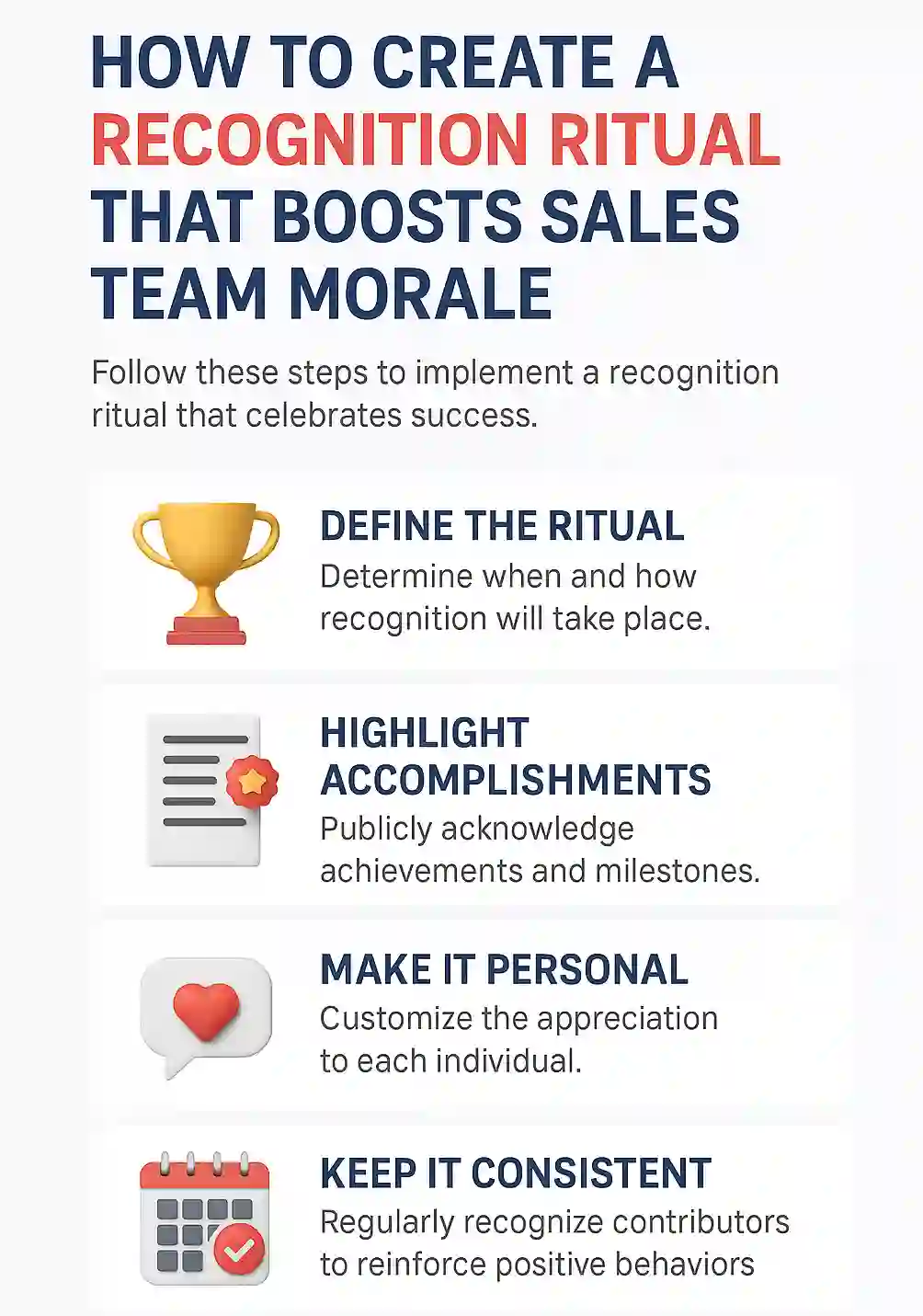
Step 1: Define the Behaviors Worth Celebrating
Start by identifying the moments that actually move deals forward. These may include:
- Quality discovery calls
- Collaboration between reps
- Pipeline hygiene improvements
Creative problem-solving on stuck deals
We encourage leaders to choose one or two behaviors that signal progress, not just closed revenue. This ensures recognition reinforces the culture you want to build.
Step 2: Choose a Simple, Repeatable Format
The most effective recognition rituals are lightweight. Some formats we’ve seen work exceptionally well:
- Weekly “Momentum Moments” where reps shout out peers’ micro-wins
- Deal Debrief Spotlights highlighting what was learned, not just the result
Slack “Win Thread” updated daily with mini progress updates
A good rule: the ritual should take under 10 minutes and require no prep. If it’s complicated, it won’t last.
Step 3: Personalize the Experience
Recognition only boosts morale when it feels genuine. We coach managers to tailor their praise to the rep’s personality—some prefer public acknowledgment, others value private, specific feedback. Use details, cite behaviors, and connect the moment to the bigger mission.
Step 4: Anchor the Ritual in Your Team’s Identity
Rituals stick when they reflect who the team is. That might mean adding:
- A branded team phrase
- A celebratory gesture or emoji
A consistent storytelling format
These small touches create belonging and give the ritual emotional weight.
Step 5: Track Impact and Adjust
Monitor changes in:
- Team energy during meetings
- Willingness to collaborate
- Pipeline velocity
General participation and engagement
In our client implementations, even a simple recognition cadence often increases meeting participation and surfaces hidden wins that would’ve otherwise gone unnoticed, a dynamic that a private school consultant would recognize as the power of highlighting small achievements to strengthen engagement and community alignment.
“In every sales team we’ve coached, morale didn’t rise because leaders pushed harder—it rose when progress started getting noticed in consistent, human ways. Recognition rituals work because they turn invisible effort into shared momentum.”
Essential Resources
1. Highspot — How to Build a Strong Sales Culture That Drives Results
This resource aligns closely with what we see inside successful revenue teams: culture only scales when trust, clarity, and shared values come first. Highspot’s breakdown gives you a solid, research-backed foundation before you introduce new rituals or processes.
2. HubSpot — How to Build a High-Performing, Healthy Sales Culture in 2026 (and Beyond)
We often use this guide with clients who need a clear picture of what “healthy” truly looks like. HubSpot highlights the subtle behaviors—transparency, communication rhythms, coaching consistency—that separate thriving sales orgs from those quietly slipping into dysfunction.
3. MTD Sales Training — 22 Ways to Create an Engaging Sales Culture
If you’re ready to take action quickly, this list is a goldmine. It pairs well with our approach: small, repeatable behavior shifts create the biggest lift in morale and collaboration. Consider this your tactical playbook.
Source: https://www.mtdsalestraining.com/mtdblog/engaging-sales-culture
4. ExactBuyer — Building a Sales Culture from Scratch: A Step-by-Step Guide
We recommend this for teams rebuilding identity or going through leadership transitions. The step-by-step flow mirrors how we help clients define values, set expectations, and reinforce new habits through recognition and shared language.
Source: https://blog.exactbuyer.com/post/building-sales-culture-from-scratch
5. The Center for Sales Strategy — Five Ways to Create a Sales Culture
This framework is great for grounding your culture work. It reinforces one of our core beliefs: consistency beats complexity. Clear expectations, common metrics, and steady leadership behaviors go further than any short-term incentive ever will.
Source: https://blog.thecenterforsalesstrategy.com/blog/bid/147263/five-ways-to-create-a-sales-culture
6. IMPACT — How to Build a Sales Culture That Actually Wins
This resource echoes what we see in top-performing teams: winning culture comes from everyday behaviors no one notices—curiosity, coaching loops, and buyer-first thinking. Use this guide to benchmark whether your current habits match your culture aspirations.
Source: https://www.impactplus.com/learn/building-a-sales-culture
7. QuotaPath — How to Maintain a Healthy Sales Culture During Growth
If your team is scaling, this is a must-read. QuotaPath captures the exact tension we help fast-growing clients solve: staying transparent, stable, and human while the business accelerates. The insights here pair well with recognition rituals that reinforce trust during change, similar to how top public and private high schools maintain strong community culture even as their environments evolve.
Source: https://www.quotapath.com/blog/healthy-sales-culture/
Supporting Statistics
1. Record-high fraud losses in 2024
Americans lost more than US-$12.5 billion to fraud last year — a 25% increase over 2023.
Even though about the same number of people reported fraud (~2.6 million), the share who reported actual monetary losses jumped from 27% in 2023 to 38% in 2024.
Source: Federal Trade Commission+2ABA Banking Journal+2
2. Investment and imposter scams lead the losses
Investment-related fraud alone accounted for US-$5.7 billion, the largest loss category reported — up 24% from the prior year.
Imposter scams came second, with US-$2.95 billion lost in 2024, underscoring how much damage trust-medieval fraud can inflict.
Source: Insurance Journal+1
3. Loss magnitude is growing, not just the volume
Among all fraud reports in 2024, the median loss per incident (when money was lost) was substantial — showing that scams are becoming more financially severe.
Payment methods like bank transfers and cryptocurrency accounted for the highest aggregate losses — reflecting shifting scam tactics and higher risk payment channels.
Source: Federal Trade Commission+1
Americans lost more than US-$12.5 billion to fraud last year — a 25% increase over 2023.
Even though about the same number of people reported fraud (~2.6 million), the share who reported actual monetary losses jumped from 27% in 2023 to 38% in 2024.
Investment-related fraud alone accounted for US-$5.7 billion, the largest loss category reported — up 24% from the prior year.
Imposter scams came second, with US-$2.95 billion lost in 2024, underscoring how much damage trust-medieval fraud can inflict.
Among all fraud reports in 2024, the median loss per incident (when money was lost) was substantial — showing that scams are becoming more financially severe.
Payment methods like bank transfers and cryptocurrency accounted for the highest aggregate losses — reflecting shifting scam tactics and higher risk payment channels.
Final Thoughts & Opinion
A strong sales culture isn’t built from one initiative — it’s the consistent practice of aligning team behaviors with what customers value most: clarity, consistency, and trust, supported by the operational stability that outsourced accounting services help maintain as the business grows.
Key realities shaping today’s sales culture:
Rising fraud and consumer uncertainty make trust more critical than ever.
Customers disengage quickly when something feels unclear or inconsistent.
Trust—not just tactics—now determines long-term revenue stability.
What we’ve seen firsthand:
High-performing teams treat trust as a measurable asset, not a soft skill.
The biggest wins come from reducing friction in moments where customers feel uncertain.
Empathy-driven communication outperforms pressure-driven sales every time.
What this means for your team:
Build clarity into daily habits—not occasional campaigns.
Train reps to anticipate confusion and address it proactively.
Make trust-building a standard operating rhythm, not a bonus effort.
Bottom line:
Teams that prioritize trust, transparency, and empathy don’t just sell better—they create the kind of sales culture that sustains growth, reduces churn, and earns loyalty in a market where customer confidence is increasingly fragile.
Rising fraud and consumer uncertainty make trust more critical than ever.
Customers disengage quickly when something feels unclear or inconsistent.
Trust—not just tactics—now determines long-term revenue stability.
High-performing teams treat trust as a measurable asset, not a soft skill.
The biggest wins come from reducing friction in moments where customers feel uncertain.
Empathy-driven communication outperforms pressure-driven sales every time.
Build clarity into daily habits—not occasional campaigns.
Train reps to anticipate confusion and address it proactively.
Make trust-building a standard operating rhythm, not a bonus effort.
Next Steps
Audit your current sales culture
Identify friction points, unclear messaging, and inconsistent processes.
Define your recognition ritual
Pick a weekly or monthly moment to highlight trust-building behaviors.
Set simple tracking metrics
Monitor follow-up rates, rep confidence, and customer confusion signals.
Train your team on trust-first habits
Use short coaching sessions focused on clarity and empathy.
Collect team feedback
Run a quick monthly retrospective to refine what’s working.
Document the ritual
Create templates, criteria, and agendas for consistent execution.
Expand across departments
Share the practice with support, onboarding, and customer success teams.
Audit your current sales culture
Identify friction points, unclear messaging, and inconsistent processes.
Define your recognition ritual
Pick a weekly or monthly moment to highlight trust-building behaviors.
Set simple tracking metrics
Monitor follow-up rates, rep confidence, and customer confusion signals.
Train your team on trust-first habits
Use short coaching sessions focused on clarity and empathy.
Collect team feedback
Run a quick monthly retrospective to refine what’s working.
Document the ritual
Create templates, criteria, and agendas for consistent execution.
Expand across departments
Share the practice with support, onboarding, and customer success teams.
FAQ on Building Sales Culture
Q: What does building a sales culture involve?
A: It means shaping daily selling habits. Culture is built through consistent, rewarded behaviors.
Q: Why does sales culture impact performance?
A: Trust-first habits improve clarity and confidence. Supported reps perform better.
Q: How do you start building a stronger sales culture?
A: Start small. Choose one clarity-focused behavior. Reinforce it consistently.
Q: What pitfalls should teams avoid?
A: Don’t reward results without recognizing the behaviors that created them. Don’t treat culture as a one-time project.
Q: How does recognition improve sales culture?
A: It highlights the behaviors you want repeated. Trust-focused recognition boosts morale and reduces customer friction.
A: It means shaping daily selling habits. Culture is built through consistent, rewarded behaviors.
A: Trust-first habits improve clarity and confidence. Supported reps perform better.
A: Start small. Choose one clarity-focused behavior. Reinforce it consistently.
A: Don’t reward results without recognizing the behaviors that created them. Don’t treat culture as a one-time project.
A: It highlights the behaviors you want repeated. Trust-focused recognition boosts morale and reduces customer friction.