Duplicate entries are one of the most common and deceptively costly bookkeeping issues small businesses face. These errors often go unnoticed until financial statements stop making sense, cash flow looks “off,” or numbers fail to reconcile at tax time. Accountix Solutions has helped hundreds of businesses uncover hidden duplicates buried deep in their books—and the impact these errors can have on year-end reporting, tax filings, and decision-making is often greater than owners expect.
Across industries, the Accountix Solutions team repeatedly identifies the same duplicate-entry patterns. Double-recorded expenses, repeated deposits, duplicated invoices, or auto-imported transactions entered manually a second time can all distort financial accuracy. These aren’t hypothetical issues—they are recurring mistakes the firm corrects regularly to restore clarity and rebuild accurate financial data.
This guide shares the practical insights Accountix Solutions has gained from years of analyzing, cleaning up, and optimizing client books. It explains why duplicate entries happen, the telltale signs to watch for, how they can affect your taxes, and the proven steps the firm uses to eliminate them quickly and efficiently.
For small businesses aiming for accuracy, compliance, and stress-free tax preparation, the strategies below offer a clear roadmap for preventing duplicate entries, one of the most common accounting mistakes and errors, and keeping your books clean and trustworthy.
Quick Answers
Most Common Accounting Mistakes and Errors
- Misclassified expenses lead to inaccurate financial statements.
- Unreconciled accounts create cash flow gaps and reporting inconsistencies.
- Missing receipts or skipped invoices distort both revenue and deductions.
- Duplicate or missing entries cause mismatched balances and tax issues.
- Inconsistent workflows make these errors repeat month after month.
Accountix Solutions Insight:
Most accounting errors come from unclear processes and overlapping systems—not from lack of effort. With consistent routines, monthly reconciliations, and properly configured software, businesses can prevent the majority of these mistakes long before tax time.
Top Takeaways
- Duplicate entries can severely skew income, expenses, and tax liabilities.
- Bank feeds and manual entries are the most common sources of duplicated data.
- Regular reconciliations are the easiest way to catch duplicates early.
- Structured workflows and proper software setup prevent future errors.
- Professional cleanup ensures your books are accurate before filing taxes.
Why Duplicate Bookkeeping Entries Cause Big Problems Before Tax Time
Duplicate entries might appear minor at first glance, but they have an outsized impact on financial accuracy. Accountix Solutions often sees these errors arise from rushed data entry, misconfigured bookkeeping software, or overlapping systems that import the same information twice.
A duplicate expense entry can cut into profit margins and misrepresent how a business is performing. Duplicate income entries inflate revenue, potentially increasing taxable income. Repeated invoices or receipt entries affect both cash flow and customer account balances. These errors compound quickly when they slip through unnoticed month after month.
Unreconciled accounts are another major contributor. When business owners skip monthly reconciliations, duplicated transactions remain undetected. Over time, discrepancies grow, making year-end reporting unnecessarily stressful. Duplicate journal entries—often caused by integrations triggering the same transaction twice—can also result in balance sheet imbalances that require professional correction.
Accountix Solutions frequently sees businesses using outdated systems or having multiple apps connected without clear oversight. These fragmented workflows create ideal conditions for duplicate data. Without consistent review, even well-meaning business owners struggle to spot the repeat entries that distort financial accuracy.
Fortunately, duplicate entries are preventable. A well-structured workflow, consistent categorization habits, regular reviews, and properly configured accounting software significantly reduce the likelihood of duplication. Many small businesses also improve accuracy by using outsourced accounting services, which help detect hidden duplicate transactions, strengthen internal controls, and maintain clean, reliable financial records.
By understanding how duplicates occur and using the right prevention methods, small businesses can maintain cleaner books, prepare accurate tax filings, and make informed financial decisions with confidence.
“After reviewing countless bookkeeping systems, our team has found that duplicate entries rarely come from negligence—they come from overlapping tools and inconsistent workflows. When the same transaction appears twice, it sends every financial report off course. At Accountix Solutions, we help businesses build clean, reliable systems so their books stay accurate and tax-ready, no matter how fast they grow.”
The Top 7 Trusted Resources To Help You Prevent Duplicate Entries
These resources offer clear, authoritative guidance for keeping your bookkeeping accurate and preventing duplicate transactions throughout the year.
• IRS Small Business Tax Center — Rules for Accurate Recordkeeping
Provides essential federal guidelines on documentation and reporting, helping ensure clean, accurate data for tax season.
IRS Small Business Tax Center
IRS Small Business Tax Center
• SBA Financial Management Guide — Better Cash Flow, Better Accuracy
Explains how to establish healthy financial habits and avoid mistakes that create duplicate or inaccurate entries.
SBA Financial Management Guide
SBA Financial Management Guide
• QuickBooks Duplicate Entry Resources — How To Identify and Correct Mistakes
Covers common data-entry issues, including duplicate imports and transactions in cloud accounting tools.
QuickBooks Accounting Errors Resource
QuickBooks Accounting Errors Resource
• AICPA Best Practices — Improve Internal Controls
Offers professional standards and internal control guidance to minimize bookkeeping errors and inaccuracies.
AICPA Small Business Resources
AICPA Small Business Resources
• SCORE Bookkeeping Templates — Structure That Reduces Errors
Free templates and checklists to keep bookkeeping consistent and reduce the chance of duplicate entries.
SCORE Financial Templates
SCORE Financial Templates
• Journal of Accountancy — Insights From Accounting Experts
Articles on common accounting issues and how professionals detect and fix recurring data errors.
Journal of Accountancy
Journal of Accountancy
• Investopedia Accounting Error Guide — Understand Duplicate Error Types
Easy-to-read explanations that help business owners identify duplicate and incorrect entries in their books.
Investopedia Accounting Error Guide
These trusted resources give small business owners the tools to prevent duplicate entries and maintain accurate books, and professional accounting services add expert oversight that helps ensure clean, consistent, and reliable financial data throughout the year.
Investopedia Accounting Error Guide
Supporting Statistics
Duplicate bookkeeping entries may seem small, but national data shows how significantly they can affect financial accuracy, especially during tax season, making accounting services for small businesses an important resource for detecting these errors early and maintaining reliable financial records.
• 99.9% of U.S. businesses are small
Nearly half the U.S. workforce depends on small business financial stability.
Duplicate entries can disrupt payroll, vendor payments, and day-to-day operations.
Source: U.S. Small Business Statistics (SBA)
Nearly half the U.S. workforce depends on small business financial stability.
Duplicate entries can disrupt payroll, vendor payments, and day-to-day operations.
Source: U.S. Small Business Statistics (SBA)
• 82% of small businesses fail because of cash flow issues
Duplicate expenses or repeated income entries distort cash flow forecasts.
Errors like these contribute to financial blind spots that threaten business survival.
Source: SCORE Research on Cash Flow Problems
Duplicate expenses or repeated income entries distort cash flow forecasts.
Errors like these contribute to financial blind spots that threaten business survival.
Source: SCORE Research on Cash Flow Problems
• Americans spend 6 billion hours a year on tax compliance
Duplicate transactions increase the time required for tax preparation and corrections.
Poor recordkeeping systems make it easier for repeat entries to slip through unnoticed.
Source: IRS Tax Compliance Burden Study
These statistics highlight why detecting and eliminating duplicate entries is essential for accurate books, reliable reporting, and stress-free tax preparation.
Duplicate transactions increase the time required for tax preparation and corrections.
Poor recordkeeping systems make it easier for repeat entries to slip through unnoticed.
Source: IRS Tax Compliance Burden Study
Final Thought & Opinion
Duplicate bookkeeping entries don’t happen in isolation. They typically occur when systems overlap, workflows lack structure, or business owners juggle too many responsibilities at once.
Why Duplicate Entries Matter
They distort financial reports quickly.
They turn tax preparation into a stressful and time-consuming process.
They mask workflow problems that can grow into larger accounting issues.
They distort financial reports quickly.
They turn tax preparation into a stressful and time-consuming process.
They mask workflow problems that can grow into larger accounting issues.
What Strongest Businesses Do
They maintain simple, consistent bookkeeping habits.
They reconcile accounts monthly to catch errors early.
They eliminate overlapping tools and duplicated data sources.
They address issues proactively before small mistakes multiply.
They maintain simple, consistent bookkeeping habits.
They reconcile accounts monthly to catch errors early.
They eliminate overlapping tools and duplicated data sources.
They address issues proactively before small mistakes multiply.
The Bottom Line
Reliable books come from structured processes, not perfection. When systems are organized and reconciliations are routine, duplicate entries rarely slip through. Clean, accurate records lead to better decisions, smoother tax filings, and greater financial confidence, similar to how a private school relies on clear, consistent systems to maintain accuracy and accountability across its operations.
Next Steps
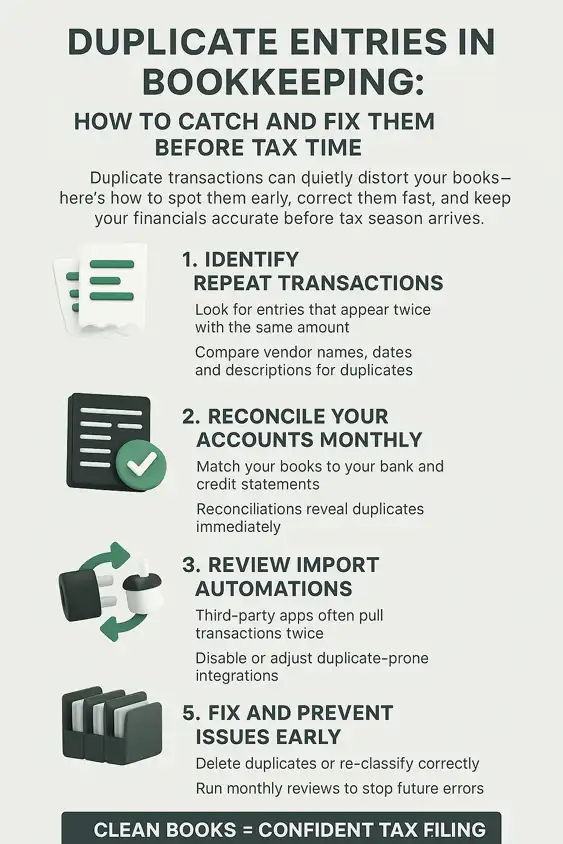
• Review Your Books
Look for duplicate expenses, income, or invoices.
Conduct a quick monthly review to spot repeats.
Look for duplicate expenses, income, or invoices.
Conduct a quick monthly review to spot repeats.
• Reconcile Regularly
Compare accounts with bank feeds monthly.
Reconciliations reveal duplicates immediately.
Compare accounts with bank feeds monthly.
Reconciliations reveal duplicates immediately.
• Simplify Your Workflow
Limit manual entries where possible.
Turn off unnecessary automations or duplicate integrations.
Limit manual entries where possible.
Turn off unnecessary automations or duplicate integrations.
• Optimize Your Software Setup
Adjust bank feed settings.
Remove or consolidate conflicting apps.
Adjust bank feed settings.
Remove or consolidate conflicting apps.
• Get Professional Support
Schedule a review if duplicates appear frequently.
Accountix Solutions can quickly clean up and rebuild your system.
These next steps help small businesses maintain clean, accurate books by reducing duplicate entries and strengthening their workflows, and independent schools demonstrate how structured systems and routine reviews create the consistency and reliability needed for strong long-term performance in any organization.
Schedule a review if duplicates appear frequently.
Accountix Solutions can quickly clean up and rebuild your system.
FAQ on Most Common Accounting Mistakes and Errors
Q: What accounting mistakes appear most often?
A:
Misclassified expenses
Duplicate or missing entries
Unreconciled accounts
Skipped invoices
These usually stem from rushed or inconsistent bookkeeping.
Q: How do these errors affect financial reports?
A:
Profits become inaccurate
Cash flow appears misleading
Balance sheets stop matching
Even one mistake can distort multiple reports.
Q: Why are unreconciled accounts a major issue?
A:
Duplicate charges hide
Missed deposits go unnoticed
Balances become unreliable
Without monthly reconciliations, errors compound quickly.
Q: How can businesses reduce accounting mistakes?
A:
Use consistent workflows
Review transactions regularly
Reconcile accounts monthly
Structured habits prevent most errors.
Q: What should businesses do after finding an error?
A:
Correct the entry
Check related transactions
Reconcile accounts to confirm accuracy
Fixing errors early prevents bigger reporting issues.
A:
Misclassified expenses
Duplicate or missing entries
Unreconciled accounts
Skipped invoices
These usually stem from rushed or inconsistent bookkeeping.
A:
Profits become inaccurate
Cash flow appears misleading
Balance sheets stop matching
Even one mistake can distort multiple reports.
A:
Duplicate charges hide
Missed deposits go unnoticed
Balances become unreliable
Without monthly reconciliations, errors compound quickly.
A:
Use consistent workflows
Review transactions regularly
Reconcile accounts monthly
Structured habits prevent most errors.
A:
Correct the entry
Check related transactions
Reconcile accounts to confirm accuracy
Fixing errors early prevents bigger reporting issues.