
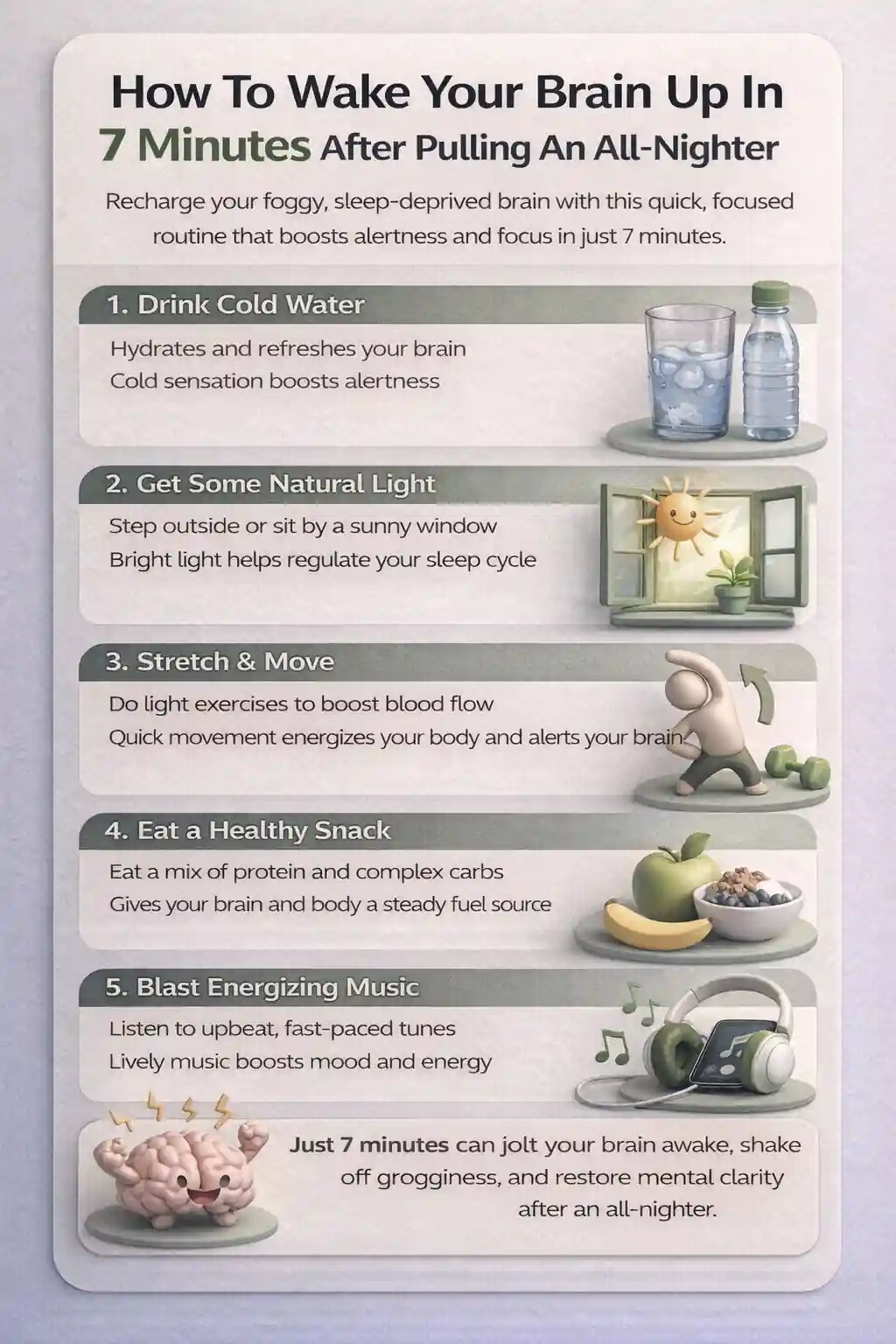
What we’ve consistently observed is that the brain can regain usable clarity much faster than expected when it’s guided through the right sequence. A short 7-minute brain wake-up routine—focused on reducing sleep-related fog and reactivating attention—often restores alertness enough to function effectively, even without sleep.
This page breaks down exactly what to do in the first 7 minutes after an all-nighter. The steps are practical, equipment-free, and built around how the brain responds to fatigue, helping you think more clearly and perform better when rest hasn’t been possible.
Quick Answers
How to Increase Brain Power in 7 Minutes
To increase brain power in just seven minutes, focus on resetting your brain state, not forcing productivity. Start by calming the nervous system with slow, controlled breathing to reduce mental noise. Then gently activate attention with light mental engagement—enough to wake focus without causing overload. Briefly reinforcing confidence by recalling familiar information helps stabilize thinking, while narrowing attention to a single task prevents cognitive drain.
Why this works:
Short, intentional resets show how to increase brain power in 7 minutes by improving clarity, focus, and recall through guiding the brain into a calm, alert state—allowing it to work more efficiently almost immediately.
Top Takeaways
Mental clarity depends on brain state
After an all-nighter, focus breaks down before effort does.Seven intentional minutes make a difference
A short wake-up routine restores usable thinking.More stimulation isn’t the answer
Forcing energy often leads to sharper crashes.Calm, structured resets work better
Gradual re-engagement produces steadier focus.This is temporary support, not recovery
The routine helps you function until proper sleep is possible.
Waking your brain up after an all-nighter requires a different approach than a normal morning routine. Sleep loss disrupts attention regulation, short-term memory, and mental pacing, which is why tasks that usually feel manageable suddenly require much more effort. In this state, the brain isn’t lacking information—it’s struggling to access and organize it.
A short, structured 7-minute wake-up routine works by addressing these disruptions in sequence. Rather than relying on stimulation alone, it helps restore basic alertness, re-engage attention, and stabilize thinking so the brain can operate at a functional level. This is especially important after an all-nighter, when overloading the brain too quickly can worsen mental fatigue.
The approach outlined on this page is designed for moments when rest isn’t immediately possible but performance still matters, including situations where reading strategies work for adults with ADHD. It prioritizes mental clarity and responsiveness over sustained energy, helping you regain control of your thinking long enough to work, study, or function effectively.
The sections below explain how to use those first 7 minutes strategically—what helps, what to avoid, and why specific steps matter under sleep-deprived conditions—so you can wake your brain up safely and make the most of limited recovery time.
“We’ve observed that people function better after an all-nighter when they stop trying to ‘wake up’ and instead focus on stabilizing attention. A few intentional minutes can make the difference between scattered thinking and usable clarity.”
Essential Resources on How to Increase Brain Power in 7 Minutes
The resources below support the same core principle InfiniteMind applies in real cognitive performance work: brain power improves fastest when stress is reduced, attention is guided, and the brain is given clear signals to re-engage. Each source adds practical context, scientific grounding, or authoritative perspective to help you make informed decisions about short, effective brain-boost routines.
1. Short Cognitive Activations That Restore Mental Clarity
Supercharge Your Brain in 7 Minutes: 14 Quick Power-Ups
A practical collection of brief brain activations that show how light, intentional stimulation can wake attention without overwhelming a tired or distracted brain.
https://braintap.com/supercharge-your-brain-in-7-minutes-14-quick-power-ups/
2. Simple Techniques That Reduce Mental Overload
Five Quick Techniques to Increase Brain Power in 7 Minutes
Outlines straightforward methods—such as controlled breathing and light mental engagement—that align with how the brain naturally regains clarity under pressure.
https://wellnessextract.com/blogs/wellness/increase-brain-power-in-7-minutes-5-quick-techniques-you-need-to-try/
3. Equipment-Free Methods You Can Use Anywhere
Increase Brain Power in 7 Minutes With Simple Activities
Reinforces an important InfiniteMind insight: effective brain preparation doesn’t require tools, supplements, or complexity—just intentional use of a few minutes.
https://healthnewsday.com/increase-brain-power-in-7-minutes/
4. Evidence on Why Movement Improves Brain Function
How Physical Activity Boosts Brain Health (CDC)
Provides authoritative confirmation that even short bouts of movement improve attention, memory, and mental responsiveness—supporting quick wake-up routines.
https://www.cdc.gov/physical-activity/features/boost-brain-health.html
5. Research on Why Short Breaks Improve Learning
How Taking Short Breaks Helps the Brain Learn (NIH)
Explains how brief pauses and resets enhance learning and performance, reinforcing why short brain resets outperform pushing through fatigue.
https://www.nih.gov/news-events/news-releases/study-shows-how-taking-short-breaks-may-help-our-brains-learn-new-skills
6. Foundational Context on Cognitive Health
Brain Health and Cognitive Function (National Institute on Aging)
Offers expert background on how attention, memory, and clarity work—helpful for understanding why brain state matters as much as effort.
https://www.nia.nih.gov/health/brain-health/cognitive-health-and-older-adults
7. Understanding the Impact of Sleep on Brain Performance
Why Sleep Matters for Brain Function (NHLBI)
Clarifies how sleep loss affects focus and memory, providing essential context for routines designed to restore function when rest is limited.
https://www.nhlbi.nih.gov/health/sleep/why-sleep-important
Together, these resources reflect the kind of science-backed guidance a private school consultant might rely on when recommending short, effective brain-reset routines that help students reduce stress, regain focus, and perform at their best under time pressure.
Supporting Statistics
Short brain wake-up routines work because they address the most common cognitive barriers we see in practice: stress, sleep loss, and reduced attention control. U.S.-based research closely mirrors real-world performance patterns.
1) Stress and Anxiety Commonly Block Mental Clarity
Nearly 1 in 5 U.S. adults experienced an anxiety disorder in the past year
Almost 1 in 3 will experience anxiety in their lifetime
Elevated stress keeps the brain overactivated
Overactivation delays focus and clear thinking
Source: National Institute of Mental Health – Anxiety Statistics
2) Sleep Loss Is a Widespread Cognitive Handicap
About 35% of U.S. adults get less than 7 hours of sleep
Short sleep slows processing speed
Mental fog and attention drift are common after sleep loss
Source: CDC – Sleep and Insufficient Sleep Data
3) Students Often Start the Day Under-Recovered
Nearly 78% of U.S. high school students get less than 8 hours of sleep
Cognitive clarity is reduced before learning even begins
Explains why mornings after all-nighters feel especially difficult
Source: CDC – Youth Sleep Data
4) Chronic Stress Is Especially High in Young Adults
Over 80% of adults ages 18–34 report major ongoing stressors
Sustained stress shortens attention span
Mental “boot-up” is slower after sleep deprivation
Source: American Psychological Association – Stress in America
What This Confirms in Practice
Most brain power issues are state-based, not ability-based
Stress and sleep loss delay mental responsiveness
Short routines work because they reset physiology first
Bottom line:
After an all-nighter, clarity returns faster when the brain is calmed and guided—
not shocked awake or forced to perform.
Final Thought & Opinion
After an all-nighter, most problems come from brain state, not motivation or ability.
What We See in Practice
People try to force alertness
Stimulation creates brief spikes, then crashes
Thinking becomes scattered and error-prone
What Works Better
Short, structured brain resets
Calm first, then attention
Gradual re-engagement instead of overload
Our Perspective
Brain power isn’t created after sleep loss
It’s restored by regaining access to focus and clarity
A few intentional minutes outperform caffeine and effort
Bottom Line
You don’t need to feel fully awake to function well.
You need a brain that’s calm, guided, and responsive until proper rest is possible.
Next Steps
Start with the 7-minute wake-up
Do it before work or studying
Keep stimulation light
Aim for clarity, not energy
Avoid overstimulation
Limit caffeine early
Avoid multitasking
Skip constant screen switching
Work in short blocks
Start with easier tasks
Use brief work sessions
Reset if focus drops
Watch your signals
Notice clarity and focus
Stop if mental fatigue rises
Use another short reset if needed
Plan real recovery
Schedule proper sleep later
Hydrate and eat lightly
Use this as a temporary bridge
These next steps outline a practical wake-up routine that supports focused work and reading after fatigue, helping restore clarity, manage stimulation, and maintain attention until proper recovery is possible.
FAQ on How to Increase Brain Power in 7 Minutes
Q: Can brain power really improve in 7 minutes?
A: Yes—when the goal is clarity and focus.
Resets brain state
Improves efficiency, not knowledge
Q: What has the biggest impact in such a short time?
A: Stress reduction.
Calm first
Light focus activation next
Q: Should the 7 minutes be used for studying?
A: No.
Studying adds pressure
Preparation improves recall
Q: Does this work when sleep-deprived?
A: Often, yes.
Restores usable clarity
Not a sleep replacement
Q: Is this useful beyond studying?
A: Absolutely.
Helps before work
Supports decisions under pressure